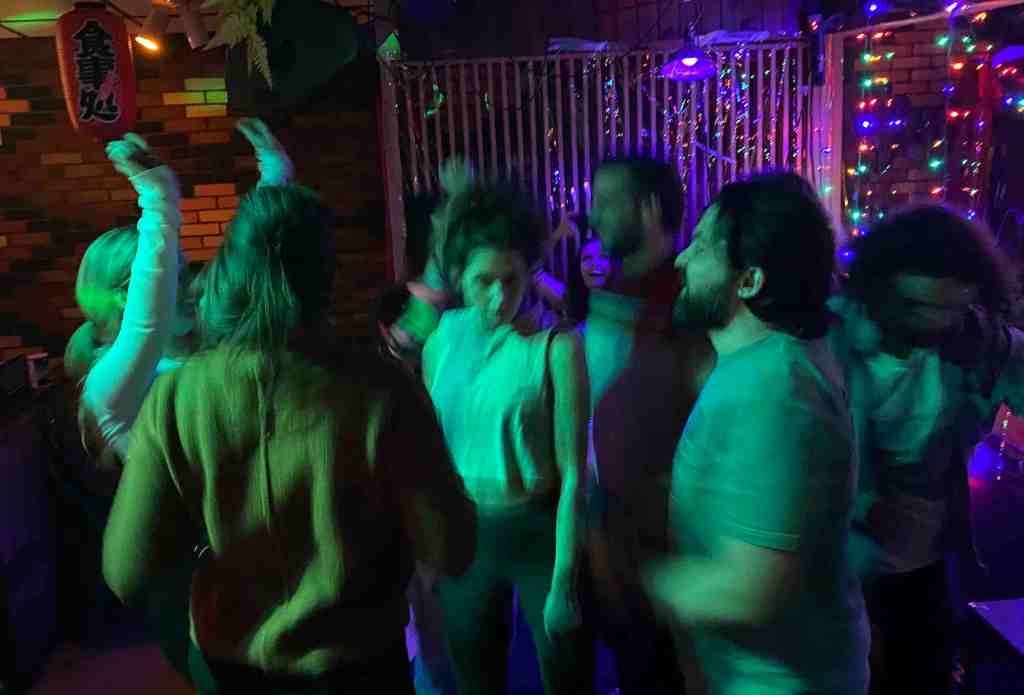
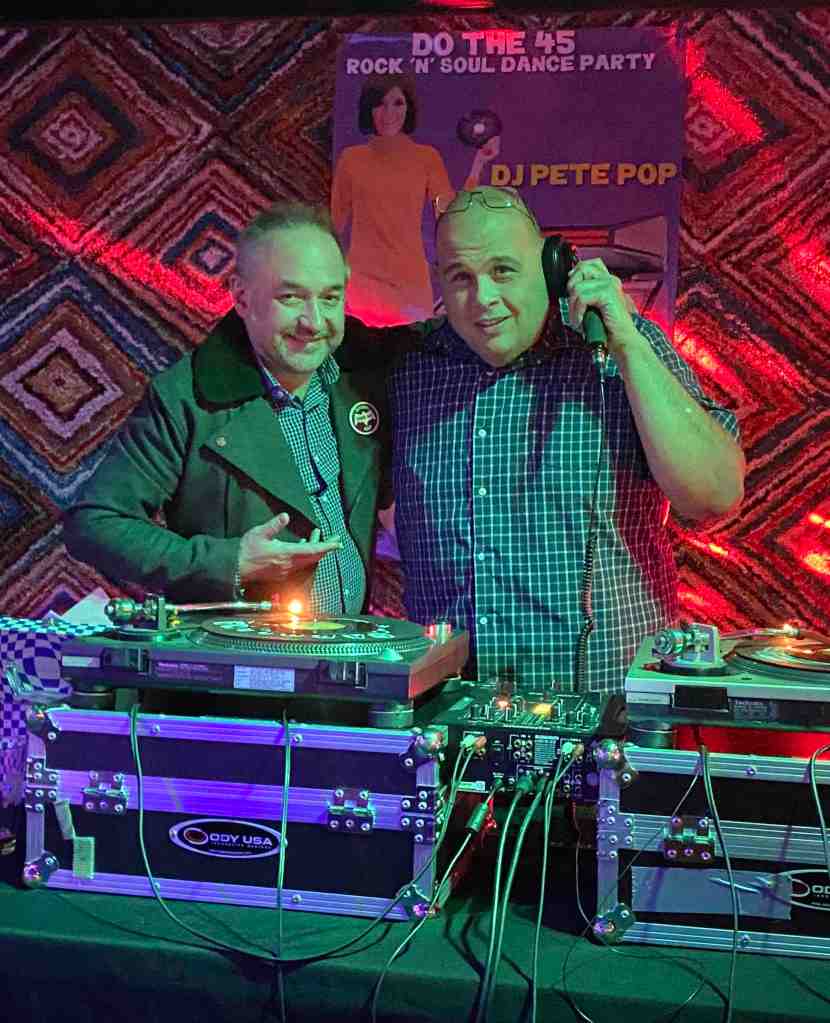
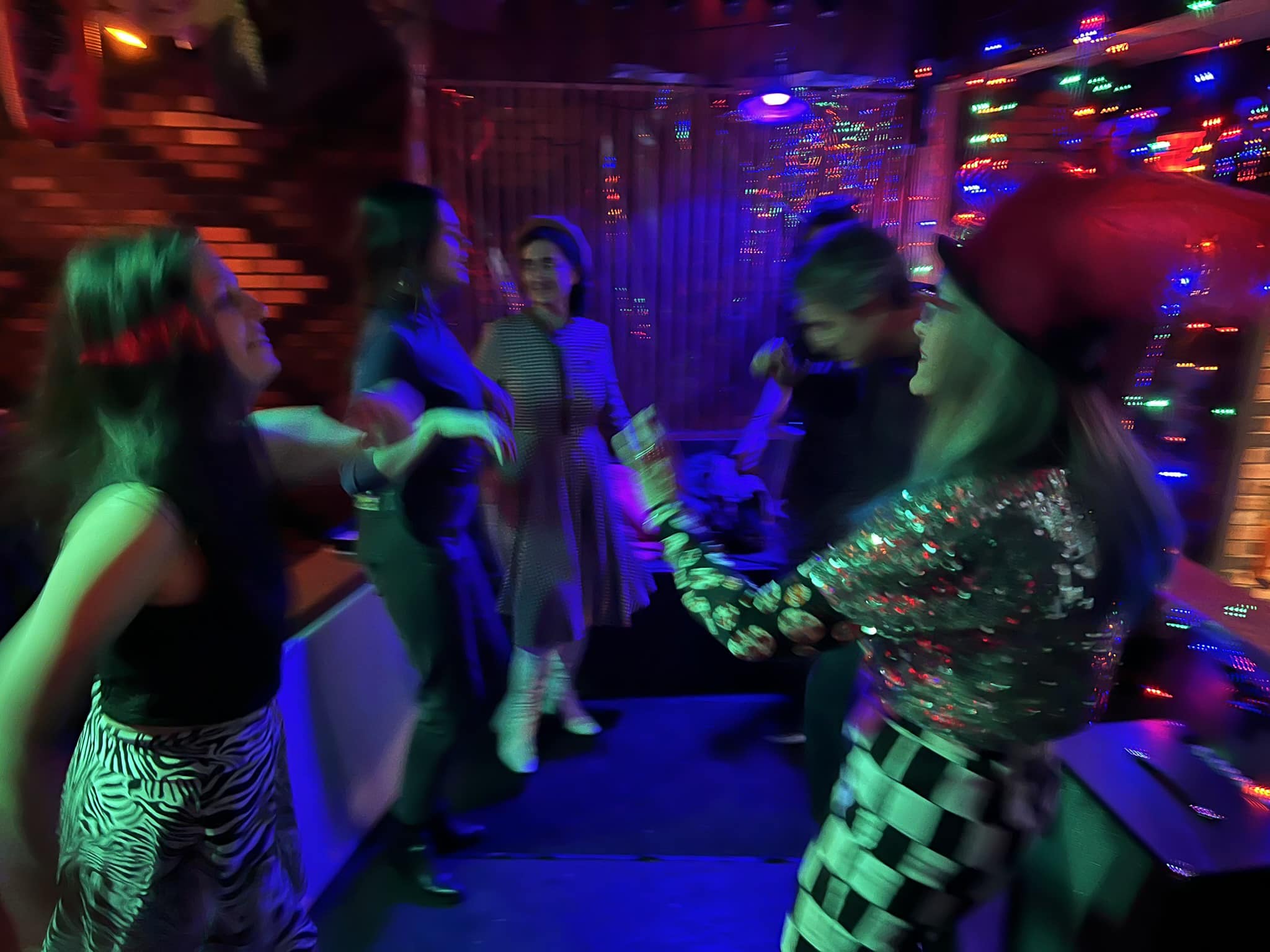
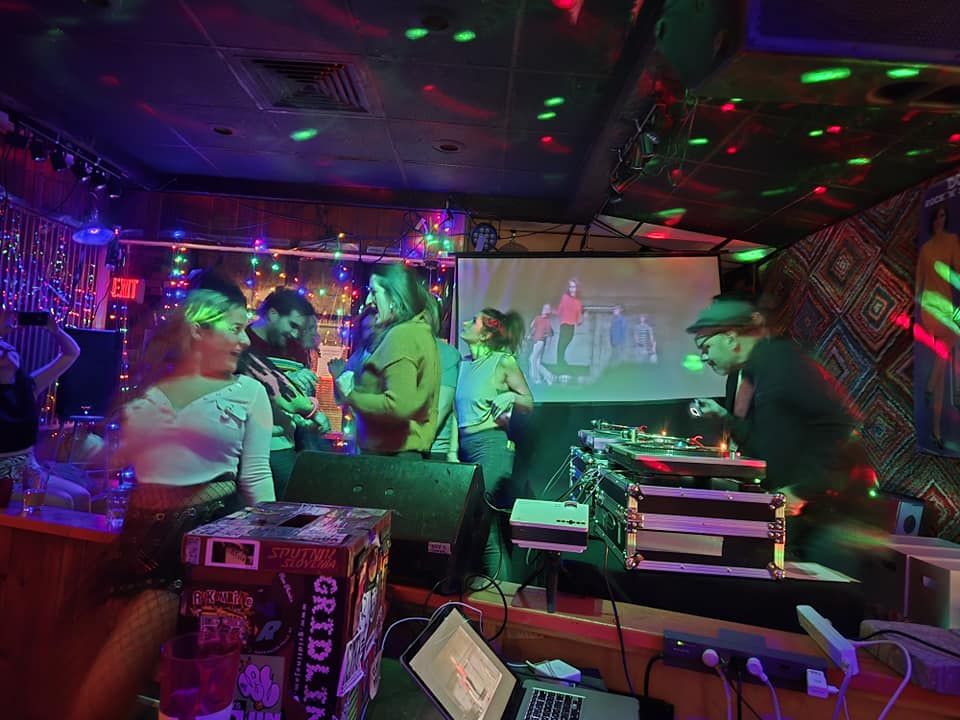
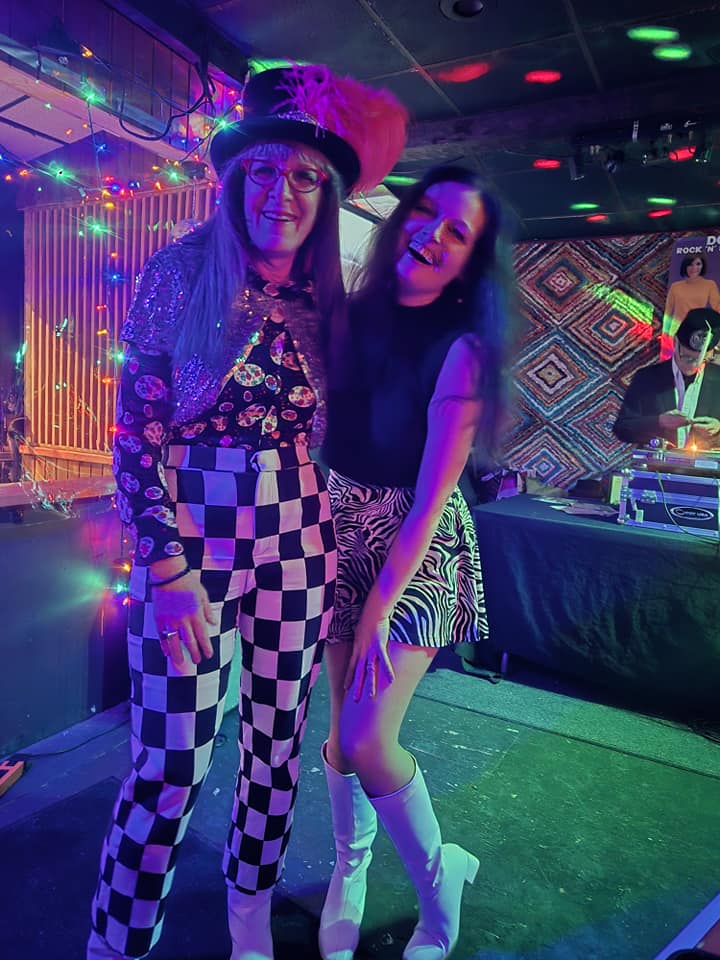
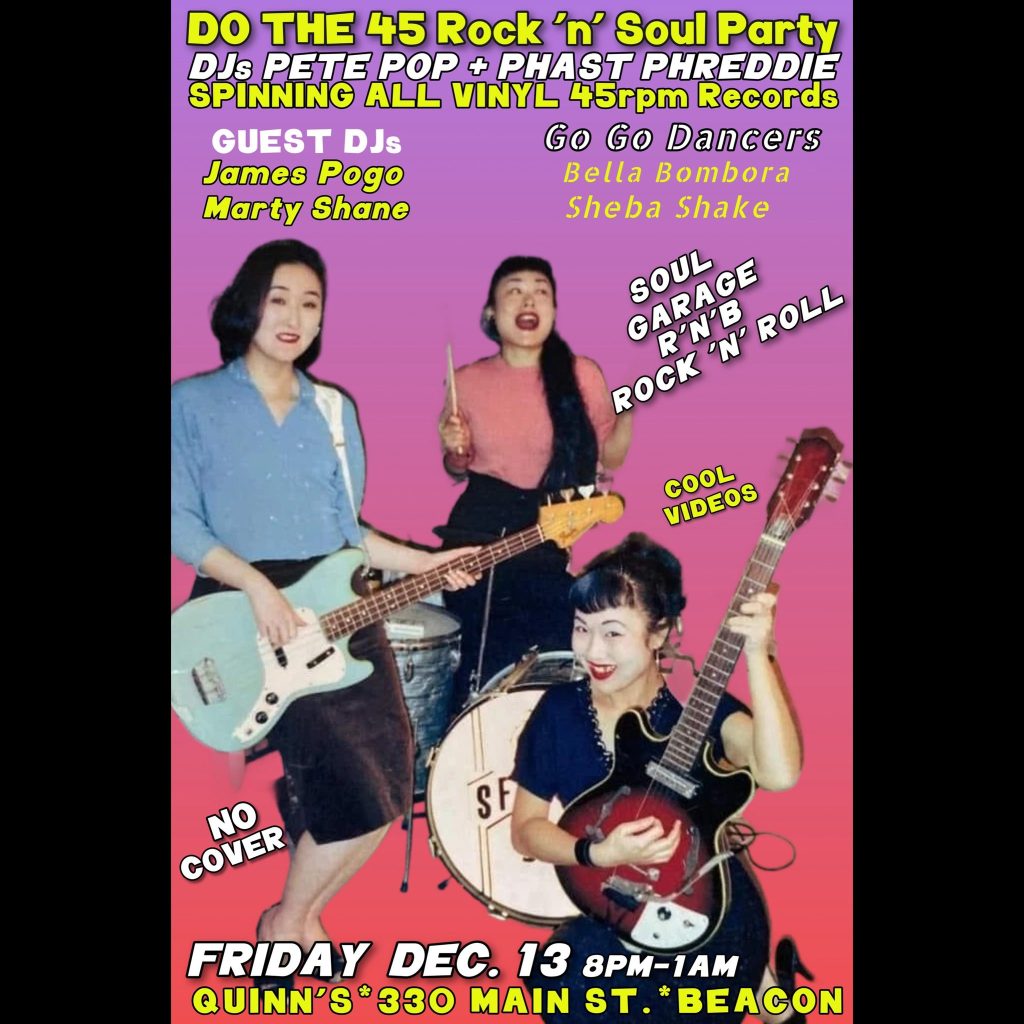
It may have been Friday the thirteenth, but Do The 45 held on that date was anything but unlucky. In fact, it may have been one of the best ones yet! All night folks were boppin’ to the boss sounds laid down by host DJ Pete Pop, his co-host Phast Phreddie the Boogaloo Omnibus and their guests Marty Shane and James Pogo. Go-Go dancer Bella Bombora performed so enthusiastically that dozens of folks got up on the raised dance floor to boogie with her throughout the night. In all, it was quite a success.
Marty Shane, again, played some pretty great records—even some seasonal ones. Much as he did last month, James Pogo delighted everybody again with his excellent selection of dance tracks. Pete Pop, of course played his fantastic records. Miss Nancy made her yummy chex mix and pumpkin cookies.
Here’s a list of all the records played by Phast Phreddie the Boogaloo Omnibus at the December Do The 45:
The GO Mechanism is an audio Odyssey scientifically engineered and programed in the secret laboratory of Boogaloo Omnibus Productions incorporating ultra-phonic techniques not available to other broadcast entities. The G stands for GROOVE, and there is always plenty of GROOVE in each GO Mechanism. The O stands for O’Roony, an intricate and complex attitude that is incomprehensible to those who possess standard-issue precepts. Listen and you will hear.
The GO Mechanism is first aired on the Luxuria Music web streaming hustle as a Saturday Night Special. It will then be available as a podcast on the Luxuria Music web site for a few weeks, then it will sit in that limbo called the Mixclouds. This one will first air on November 16, 2024.
In order to achieve total comprehension of this GO Mechanism, it is strongly suggested that the listener follow along with this blog post as he or she listens to the program. This blog will act as a guiding light, with a track listing and information regarding some of the songs featured in the show.
An hour into the GO there will be a Science Corner—a segment of the trip where we discuss a topic of musical importance. This Science Corner we will listen to three songs that feature Bo Diddley playing the violin.
Bo Diddley actually studied the violin when he was a boy. When he decided he wanted to play that instrument, the parishioners of Ebenezer Missionary Baptist Church took up a collection to buy him one. He took lessons, then he joined the Sunday school band. The teacher made him play hymns and classical pieces, but he wanted to see if he can play blues on it. He took violin lessons until he was 15. Around that time he was given a guitar as a Christmas present and that instrument took him places.
We have found three instances where he recorded with his first instrument. The sound he gets out of his violin is eerie, and not like any violin sound you’ve heard. This is clearly not Itzhak Pearlman!
“The Clock Strikes Twelve” starts like a typical Bo Diddley song, with the “I’m a Man” beat, but then soon morphs into a slow blues instrumental with the pianist Lafayette Leake and Willie Dixon on bass, and of course, Jerome Green on maracas. The song was first issued as the B-side to the 1959 novelty hit “Say Man,” then it appeared on his second album, Go Bo Diddley.
“To Each His Own,” was written for the movie of the same name in 1946. At one point that year, the song held five different spots on the Pop Top Ten chart by five different artists. Notably, one of the artists was The Ink Spots, whose version also placed high in what was then called the Most Played Juke Box Race Records chart. Bo Diddley’s violin playing is, again, very eerie, and half way through he plays it pizzicato. This track was recorded in 1959, but not issued—maybe it was deemed unworthy of release because of the plodding beat that the musicians lend to the song. But Bo’s violin playing is unique and may even be called avant-garde, especially for the time.
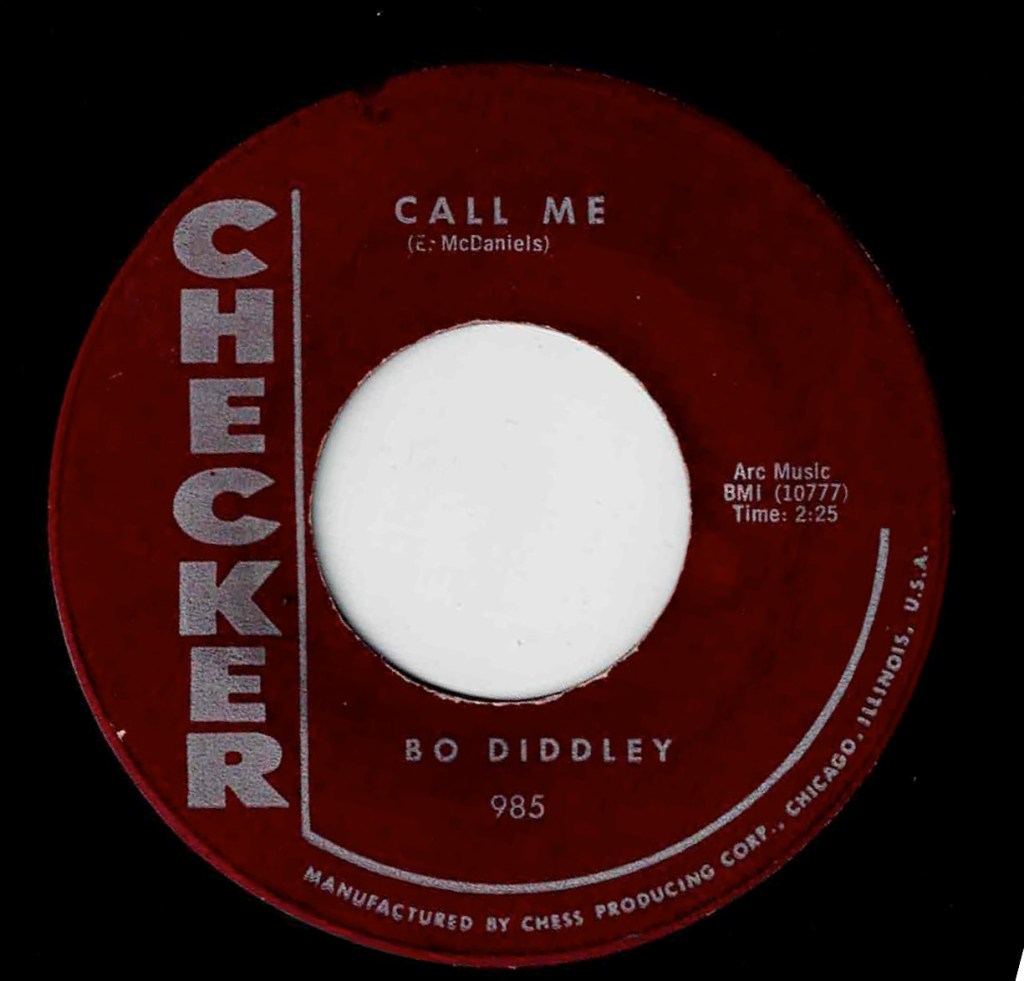
After that we will hear “Call Me.” It was recorded at Bo Diddley’s home studio in Washington, D.C. in February 1961 and it was issued as the flip-side to “Pills.” For some reason it was called “Bo’s Blues” on the album Bo Diddley Is a Lover. It’s another slow blues, with Bo singing, this time. On this track, Bo’s violin playing almost sounds like Little Walter’s harmonica playing! It really must be heard to be believed, and we will hear it in The GO Mechanism.
Along with B.B. King and Freddy King, Albert King is considered one of the “Three Kings of the Blues.” (People tend to forget the great Earl King, who made tremendous records in New Orleans—but that’s another story; perhaps even a Science Corner). Albert King was born in Mississippi and eventually moved to the Chicago area to further his career in music. He played drums in Jimmy Reed’s band, including on some of Reed’s earliest recordings. King cut a record for Parrot that did not sell well, then he moved to the St. Louis area. It is there that he became a popular draw in the thriving nightclub scene. He cut some records for Bobbin Records, a label partially owned by Little Milton. When his first single, “Don’t Throw Your Love on Me So Strong,” started to make some noise, it was picked up by King Records. The platter topped out at Number 14 on Billboard’s Hot R&B Sides chart in early 1962. In this GO Mechanism, we hear “This Morning,” an instrumental that was the flip side of “Don’t Throw…” The King Records marketing people added a little note on the white label promo copies that went out to radio stations that stated: “Attn: Disc Jocks, This instrumental will be liked by The Teenagers!” Most likely this inscription was placed there because of it’s uncanny resemblance to “Last Night” by The Mar-Keys, a smash hit during the summer of 1961. Interestingly, The Mar-Keys record was issued on Satellite Records—a Memphis company that soon renamed itself Stax Records. Five years later, Albert King was signed to Stax and it is there that his legacy was created.
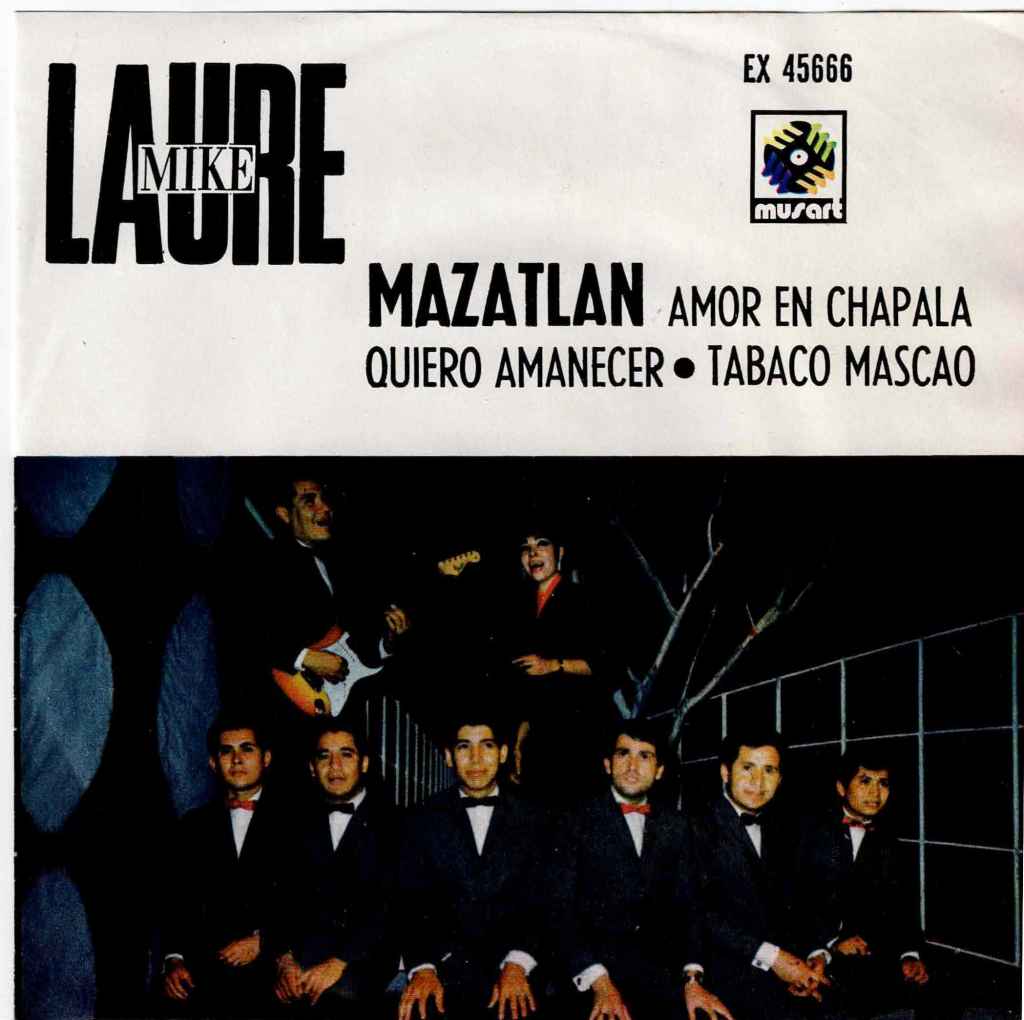
Mike Laure (pronounced mee-kay loo-ray) was one of the first Mexican musicians to perform cumbia music. In the late fifties, he formed a Rock’n’Roll group and named it “Los Cometas” after Bill Haley’s band. By 1960, he had added tropical rhythms and instruments that are more closely associated with cumbia of Colombia. Laure’s records have a more pronounced beat than most cumbia records, which employed several percussion instruments, but not a drum set. “Tabaco Mascao” is a traditional cumbia, first recorded by the Colombian group Combo Los Galleros in the late fifties. Mike Laure’s version is from 1965 and it swings with an accented beat.
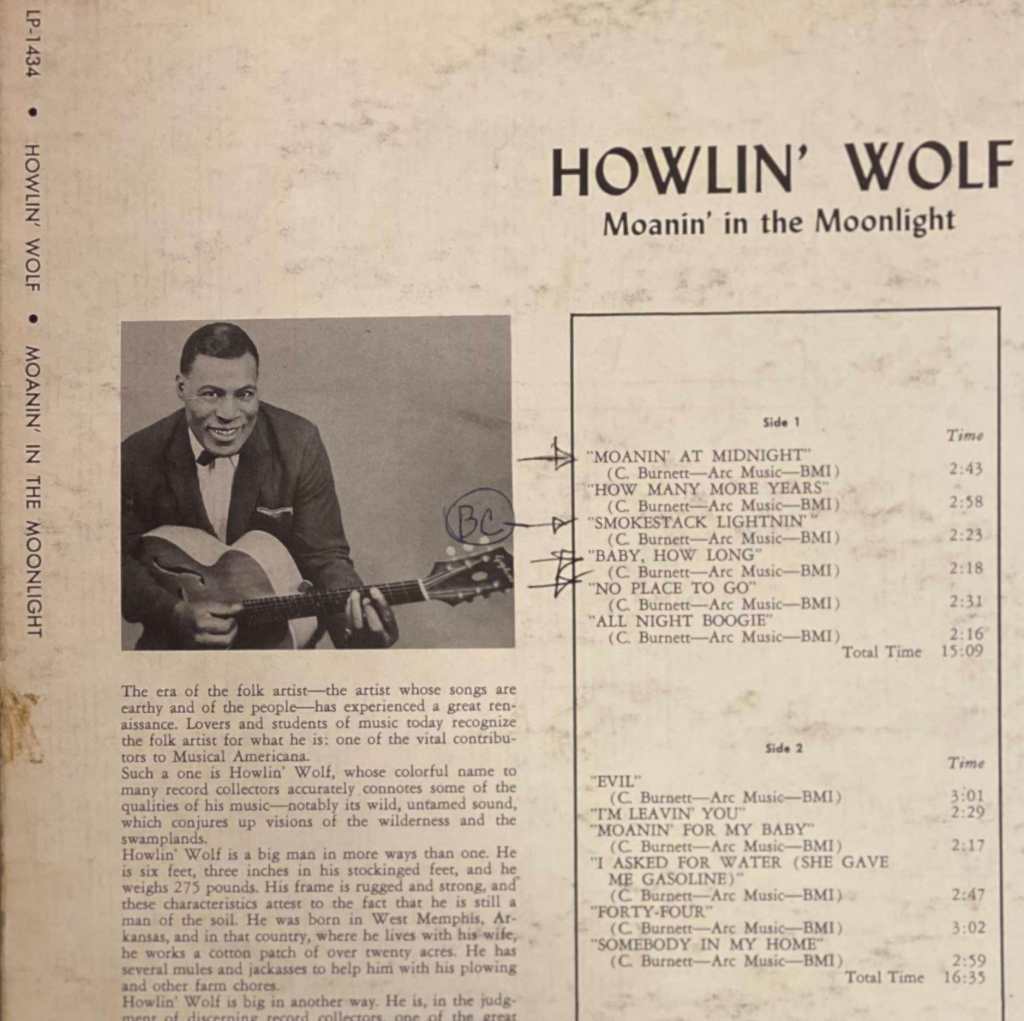
Howlin’ Wolf’s “No Place to Go” is often confused with “You Gonna Wreck My Life.” In fact, one is the alternate take of the other, but with different lyrics. On the original releases—“Place” in 1954 and “Wreck” in 1959—they showed different songwriters, too: Willie Dixon for the former and Chester Burnett (AKA Howlin’ Wolf) for the latter. Confusing matters more is the fact that they both were issued with the exact same matrix number—a number that is usually small on the label and also etched into the dead wax of the record in order that the right label is attached to the correct side when the records are assembled. Usually, a dash after the number will indicate which take is used, but no dash numbers were added to either release so, at this late date, it’s hard to tell which came first. Confusing things further is the fact that when “Place” was issued on 78 it listed Willie Dixon as the writer, but on the back cover of Howlin’ Wolf’s first album it lists the writer as C. Burnett. “Wreck” has always listed Burnett as the writer. In GO Mechanism Number 19, we played Guitar Ray’s version of “You’re Gonna Wreck My Life,” but he sings the “No Place to Go” lyric!
Are we confused yet? If not, consider also that the first line of both songs is “How many more years;” which is also the title of an earlier Howlin’ Wolf song that is only slightly related to these two! Whatever, Howlin’ Wolf is one of the all-time greats of music and we’ll be sure to hear more of his stuff in future GO Mechanisms.
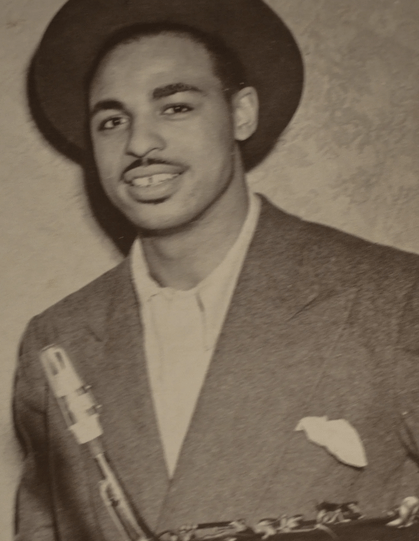
Preston Love, 1943
Preston Love was a saxophonist who came out of the big band tradition. He was born and raised in Omaha, Nebraska and he worked in several territory bands. These were orchestras that barnstormed through the South and the Midwest—many went unrecorded but all contained talented musicians that the name bands would lure to their own bands. One day, Count Basie came calling for Preston Love. During his career, Preston Love played with many of the great jazz and R&B stars of the late forties and fifties. During the sixties, Love hooked up with Motown Records and he led the bands for Motown acts when they played on the West Coast. He also made some great funk records.
Preston Love was close friends with the bandleader Johnny Otis whose long career is legendary. Otis helped Love whenever he could. During the mid fifties, when Love was unable to record, Otis issued a few records under Preston Love’s name just to keep it in the spotlight. “Ali Baba’s Boogie,” heard in this GO Mechanism, is one of those songs. The saxophonist on the record is Jackie Kelso.
Love would eventually move back to Omaha, where he became a local legend. The singer Laura Love is his daughter, his youngest son Richie Love continues the saxophone tradition and Preston Love, Jr. is a civil rights activist and recently ran for U.S. Senator in Nebraska.
Big Jay McNeely was one of our favorite saxophonists in the world. His big, honking sound was very powerful. Also, like Preston Love, he came to prominence with the help of Johnny Otis—McNeely’s first recording was with Otis in 1948. In December of that year, Big Jay recorded “Deacon’s Hop,” which topped out the R&B charts in 1949. Twenty years later, McNeely cut the record again and that’s the version heard on this installment of The GO Mechanism. As fabulous as the original version is, this is much more greasy, the beat is heavier and McNeely’s big fat tone is still in evidence—if not more so! The GO Mechanism producers were hesitant to pick up this record when it was initially offered to them, since it is on the Modern ‘Oldies Series’ label, thinking it was some sort of reissue—a Bozo no-no in the collectors’ world. However, our research shows that this is the only way it was ever available.
The Time Surfers, with Bella Bombora!
Time Surfers are a rockin’ surf-type instrumental trio based out of Newburgh, NY. The GO Mechanism producers recently witnessed one of the band’s shows at the Upper Depot Brewing Company in Hudson, NY and were able to capture its version of “The Peter Gunn Theme” on tape. Bella Bombora, one of the Go Go dancers for Pete Pop’s Do The 45 DJ night, is often seen shaking her tail feathers with the band. The Time Surfers are good and fun and deserve the attention of the GO Mechanism faithful.
Bobby Graham is considered the greatest British drummer nobody has ever heard of. During the sixties, he was the first-call session drummer in London and it is estimated that he played on about 15,000 recordings! Apparently, he’s the drummer on most, if not all, the Dave Clark Five records—not Dave Clark. He also played on records by such artists as Peter & Gordon, The Kinks, Tom Jones, Dusty Springfield, John Barry, Shirley Bassey, Joe Cocker, Rod Stewart, Petula Clark, Brenda Lee, Van Morrison and many more. In the London studios, he often played with Jimmy Page, who also worked as a session musician before he joined The Yardbirds. Here in the GO we present Graham’s super boss record “Zoom, Widge and Wag,” which was co-written with Page and the guitarist provides one of his best solos toward the end.
Freddy DeBoe is another contemporary musician worthy of consideration. He is a saxophonist from Milwaukee who made his way to New York City in order to further his career. He has worked with artists on the Daptone Records roster, including Sharon Jones, Lee Fields, Charles Bradley and James Hunter. His own band has a cool, mod jazz vibe, as heard in “Savage,” a song released on Fine Wine Records—a company owned by our friend Mr. Fine Wine, the popular WFMU disc jockey.
Once again, The GO Mechanism ends with one of the Greatest Records Of All Time: “The Ostrich” by The Primitives. Pickwick Records was a company that made its mark by selling cheesy budget albums to unsophisticated teens. Often, an album would consist of a few songs by a current popular artist, usually recorded before that artist was famous, then fill out the rest of the LP with an unknown singer from the Pickwick stable. Also, the company would issue albums of original material capitalizing on some teen fad, like hot rods or surfing. One of the musicians involved in this operation was Lou Reed. He worked for Pickwick for about a year, starting in September 1964. One of the tracks he worked on was “The Ostrich”—an amazing example of folks bangin’ on shit and screamin’ in a Rock’n’Roll context. One of the things that make this record so unique is that when Reed cut the track, he had all six of his strings tuned to the same note. By the summer of 1965, Lou Reed met John Cale at Pickwick and the two left the company to form The Velvet Underground. This story is best told in issue 60 of Ugly Things Magazine as well as in the Ugly Things podcast, where publisher Mike Stax interviews Velvet Underground expert Phil Milstein regarding this period of Lou Reed’s life. Also note that 25 tracks associated with Lou Reed during his Pickwick period have just been reissued by Light In The Attic Records on an album called Why Don’t You Smile Now: Lou Reed at Pickwick Records 1964 – 65 and it is highly recommended. There is no doubt in our mind that “this”The Ostrich” is the best record Lou Reed ever made!
A very special shout-out and ‘thank you’ goes to our friend Mike Minky, who gave a copy of “The Ostrich” to the Go Mechanism producers about 35 years ago!
Here is a complete track list of all the songs played in GO Mechanism Number 25:
Earl Bostic—Lester Leaps In (King)
Art Blakey’s Jazz Messengers with Thelonious Monk—In Walked Bud (from LP Art Blakey’s Jazz Messengers with Thelonious Monk; Atlantic)
Michael McClure—For Monk (spoken bit)
Albert King—This Morning (King)
Al Duncan—Bawana Jinde (Stacy)
Billy Larkin and the Delegates—Pigmy (Part 1) (Aura)
Ahmet Koç—Surf Rider (from album Paradoks; Doğan Müzik Dağıtım; Turkey)
Mike Laure y sus Cometas—Tabaco Mascao (Musart; Mexico)
The Ventures—Wack Wack (from LP Guitar Freakout; Dolton)
The Zodiacs—Caravan (from EP The Primitive Instrumental Sounds of The Zodiacs; Norton)
Tito Puente —Eléquana (from LP Top Percussion (RCA Victor)
Jackson Five—I Want You Back—backing track (Motown)
Howlin’ Wolf—No Place to Go (Chess)
Johnny Cale—Shock Hop (Mercury)
Preston Love & His Orchestra—Ali Baba’s Boogie (Ultra)
Jimmy Haskell—James Bond Theme (Capitol)
Susan Lynne—Don’t Drag No More (Capitol)
Beauregard and the Tuffs—Ramblin’ Rose (Decca)
Lee Fields—Let a Man Do What He Wanna Do (from LP Let’s Get a Groove On; Desco)
The Eloise Trio—Anna Ba Coha (from LP The Eloise Trio; Decca)
Big Jay McNeely—Deacon’s Hop (Modern Oldies)
Eddie Kirk—Them Bones (Volt)
Oquesta Monteria Swing—La Pua (Discos Fuentes)
King Kong Itself—The Mothers of Invention (from LP Uncle Meat; Bizarre)
Charles Mingus—Cumbia Jazz Fusion (edit from LP Cumbia Jazz Fusion; Atlantic)
Aaron Neville—Hercules (Mercury)
——Science Corner
Bo Diddley—Clock Strikes Twelve (Checker)
Bo Diddley—Diddling (Checker)
Bo Diddley—To Each His Own (from album Road Runner – The Chess Masters 1959-1960; Chess/Geffen)
Bo Diddley—Call Me (Bo’s Blues) (Checker)
Screamin’ Jay Hawkins—Africa Gone Funky (London)
The Time Surfers—Peter Gunn Theme (live recording)
Captain Beefheart & the Saxons—Golden Birdies Camel Walk (Boogaloo exclusive mash-up)
Bobby Graham—Zoom, Widge, Wag (Fontana; UK)
Symarip—These Boots Are Made for Stompin’ (Harlem Shuffle; UK)
Ornette Coleman—Free Jazz (edit) (from LP Free Jazz; Atlantic)
Dylan Thomas—Should Lanterns Shine (spoken bit)
Johnny Zorro—Bongo Guitar (Infinity)
Freddy DeBoe—Savage (Fine Wine)
Bo Jr.—Coffee Pot (Part 1) (Tail-Gate)
Perez Prado—Moliendo Cafe (RCA Victor)
Curtis Mayfield—Freddie’s Dead (closing theme/Boogaloo Edit) (Curtom)
The Primitives—The Ostrich (Pickwick City)
Peter Case’s important message (edit from Peter Case: A Million Miles Away documentary)
Once again we thank the groovy people at Luxuria Music for allowing us to present The GO Mechanism over their web-streaming hustle. Luxuria Music is a listener supported entity and can not exist without your help. Please visit the Luxuria Music website and figure out how you can send them some money.
This edition of The Go Mechanism will be available as a podcast on the Luxuria Music website after its initial air-date of November 16, 2024 as a Saturday Night Special. After a few weeks it will be posted on the Mixclouds and then it will magically appear below…











 boogaloobag